An Unusual Campaign That Alarms Facebook - Burger King's "Whopper Sacrifice"
In our Ikona Creative blog section, we evaluated the "Whopper Sacrifice" campaign from various perspectives. This campaign, from 2010 onwards, is considered one of the first examples of effective viral campaigns conducted via social media, designed to differentiate itself from competitors, create buzz, and attract attention. It was backed by a large and popular brand like Burger King and aimed to achieve this goal.
Created by the American agency Crispin Porter & Bogusky under the direction of Matt Walsh in the spring of 2009 for the Burger King brand, this viral marketing campaign had a far greater impact than expected. The campaign was ultimately terminated on its 10th day when Facebook, the most popular social media platform at the time, was forced to cancel it.
In the spring of 2009, the renowned American advertising agency Crispin Porter & Bogusky designed a compelling campaign for the Burger King brand. The agency placed Facebook, which has played a pioneering role in integrating the concept of "social media" into daily life since 2007 and has become increasingly popular thanks to its unconventional CEO Marc Zuckerberg, at the very center of the campaign. What made the campaign unusual and viral was its creative and rather risky central idea and content.
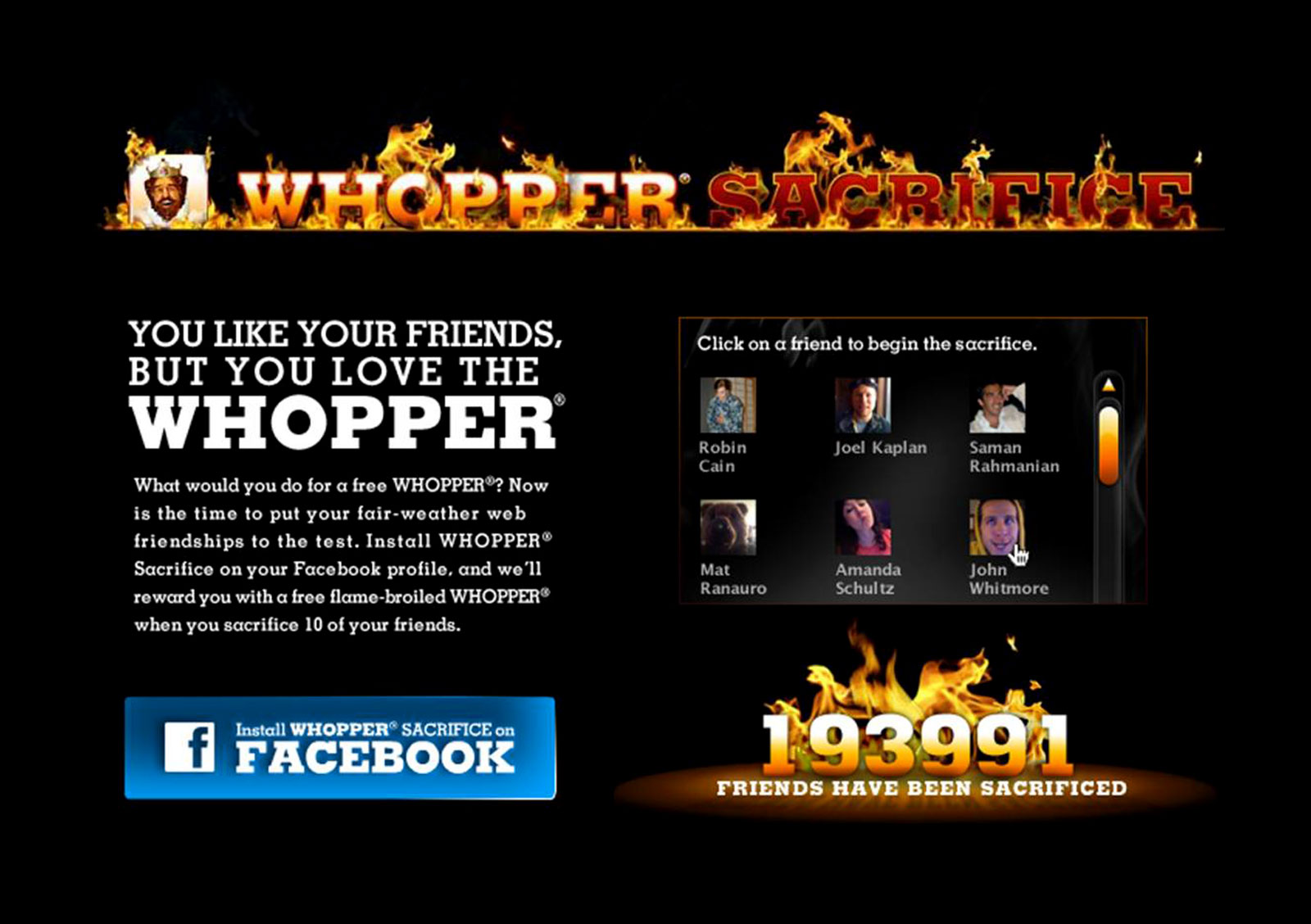
The campaign presented users with an interesting proposition via the Facebook interface: "Can you sacrifice 10 Facebook friends to win a Whopper?"
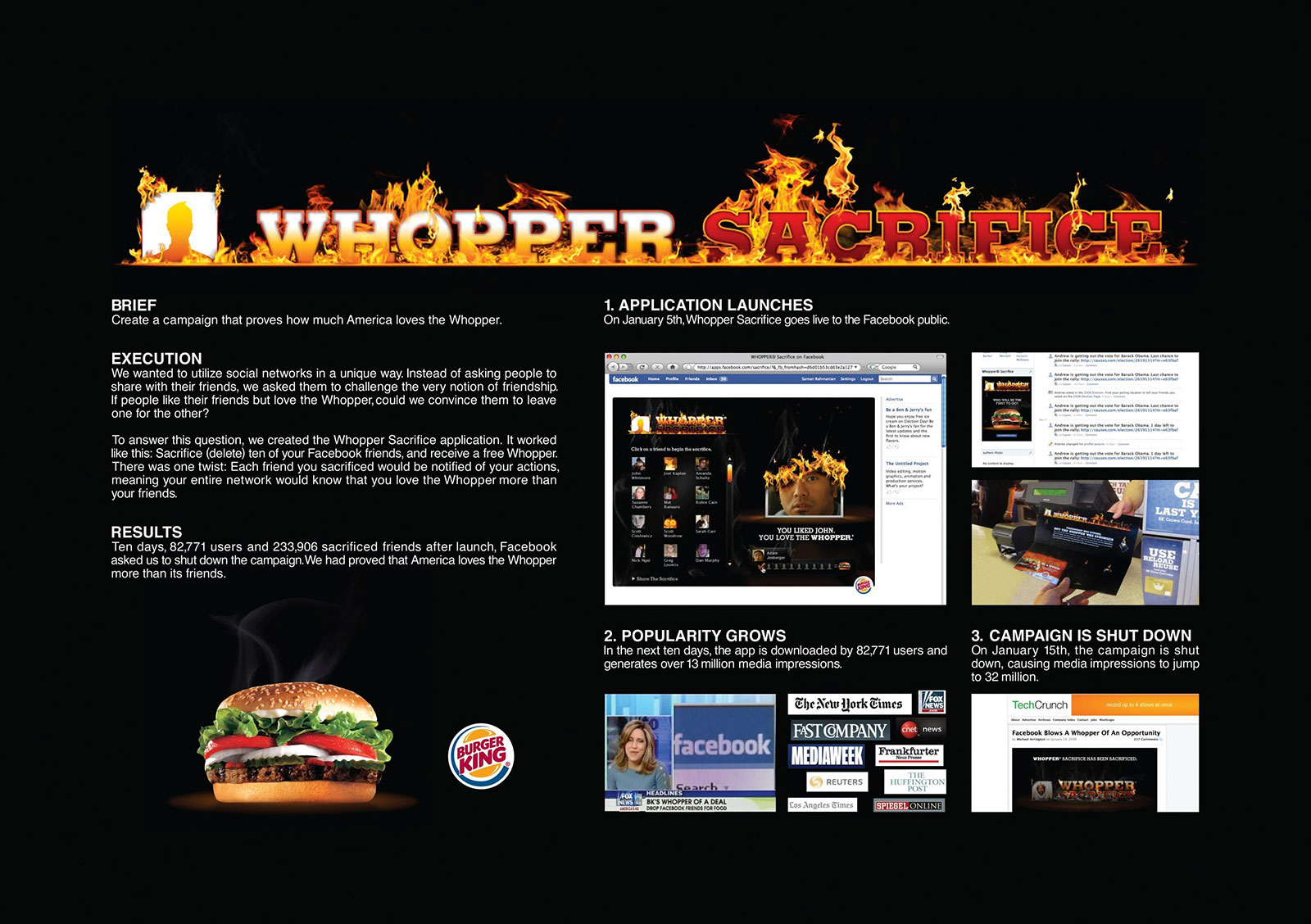
Users who were willing to delete 10 Facebook friends would win a Whopper Menu. Furthermore, the deleted friends would receive a notification indicating who deleted them, clearly stating that they were sacrificed for the Whopper.
The campaign went viral, with approximately 82,771 uses of the app and 233,906 people unfriended in 10 days. The campaign garnered a total of 35 million interactions. The extraordinary impact of the campaign, of course, disturbed Facebook, which was focused on increasing its number of participants and growing its platform day by day. Facebook decided to stop the campaign on its 10th day, citing a violation of personal rights.
The entire campaign was accomplished with a very limited social media budget, a simple press release prepared by the agency, and a few media posters. One element that made the campaign compelling was the power of people to spread it voluntarily and rapidly. Considering that many of the social media marketing and measurement tools that are quite advanced today didn't exist back then, the campaign can be considered one of the first examples of the power of social media when used correctly.
The campaign director stated that, in addition to the campaign's viral success, the duration of interaction with the product was also a crucial point and a strong point of the campaign. According to Matt Walsh, people spent more time selecting items from their friend lists while deleting them via the app, and during this time, they remained engaged with Whopper (and the brand) through the app.
Another aspect of the campaign that could be examined requires a qualitative rather than a quantitative approach. The increasingly popular concept of "Generation Z" and the consequences of young individuals born after 2000 rising to decision-making positions in society, politics, business, universities, and e-commerce are a current topic of discussion. This new generation, defined by communication theorist Marshall McLuhan as "digital natives" within the context of the "Information Society," is not merely learning about technology but being born into it and the new world. We can examine this sociological and psychological approach within the context of this campaign as well.
The social and digital media world, where different generations—from those born in the 1940s to those born in the 2000s—can socialize together using completely different languages, styles, symbols, and attitudes—with some being defined as "boomers" and others as "newcomers," can also create various divisions based on values and approaches. As campaign director Matt Walsh stated in a press release, a deeper reading of the campaign reveals that it pits a sacred, long-term concept like "friendship" against a rapidly consumable and cheap value like "eating hamburgers," and judging by the results, friendship loses. Or, looking at it from another perspective, the new behavioral trends that we first saw in the 2010s and that today strongly indicate a sociological shift suggest that a little fun won't hurt anyone…